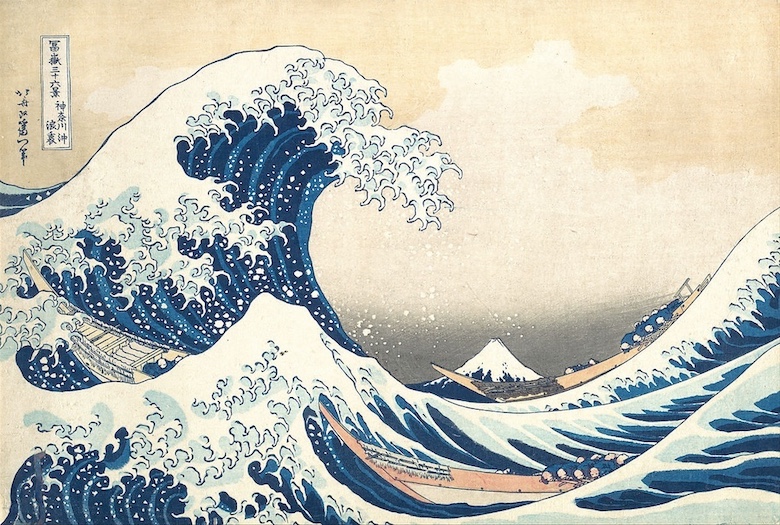
“The Great Wave” is a timeless Japanese masterpiece created by a Japanese artist, named Hokusai Katsushika (1760 -1849). He was basically a craftsman, and a paint-maker who made this “Great Wave” (39cm x 26cm) as a series of woodblock prints, which were common during that time. Although this woodblock print is Japanese, the technique used here has both Eastern and Western influences. This set was called “Thirty-six Views of Mount Fuji”.
Hokusai's “The Great Wave” shows a captivating and terrifying scene of fishermen, with their captured fish, on three separate boats. Above them is this rising Great Wave in the foreground with a view of Mount Fuji in the background. The important thing about this composition is that the viewer, just like the fishermen, is made present and watching the scene while on the ocean. The only land part that is shown is where Mount Fuji stands. This is the unique use of technical perspective by Hokusai in this artwork. In addition, he also used an imported Prussian blue pigment for making this unique woodblock print.
“The Great Wave” symbolizes the enormous forces of nature about to hit the boats beneath it; while depicting the helplessness of human beings against it. Mount Fuji symbolizes stability and is a powerful identity of Japan itself; as the symmetrical and cone shaped mountain holds a sacred place in the hearts of the Japanese people.
These woodblock prints became famous when Westerners showed interest in them and collected them. Hence, “The Great Wave” became preserved to this day unlike Hokusai’s other woodblock prints which are important however not as endeared.“The Great Wave” by Hokusai Katsushika”
To learn more about Hokusai Katsushika please visit:
The MET
The Art Institute of Chicago